Vice-President of the Inter-Parliamentary Union Dr. Avgeninopoulou Addresses Critical Global Security Concerns Amid War in Ukraine

Vice-President of the Inter-Parliamentary Union Dr. Avgeninopoulou Addresses Critical Global Security Concerns Amid War in Ukraine

Dr. Dionysia-Theodora Avgeninopoulou, Vice-President of the Inter-Parliamentary Union (IPU), delivered a compelling speech today, addressing the ongoing conflict in Ukraine and its far-reaching consequences on global security and stability.

Her remarks were made at the Third Parliamentary Summit hosted by the Parliaments of Ukraine and Latvia in Riga, with Dr. Avgeninopoulou highlighting the IPU’s firm stance against military aggression and its advocacy for international peace through parliamentary diplomacy.

Expressing her gratitude, Dr. Avgeninopoulou commended the parliaments of Ukraine and Latvia for the invitation to participate in the important discussions. “Europe is facing security challenges it had not seen since the Cold War. The war in Ukraine has shaken the foundations of international peace and stability to their core,” she stated, underscoring the severity of the current geopolitical landscape.

In her capacity as Vice-President of the IPU, Dr. Avgeninopoulou reaffirmed the organization’s strong condemnation of the Russian Federation’s military aggression. “Through two resolutions, we have strongly rejected the illegal annexation of Ukrainian territories and called on all nations to adhere strictly to the United Nations Charter and international law,” she emphasized.

Dr. Avgeninopoulou also touched upon the dangers of eroding international principles, stating that the war in Ukraine has brought the world closer to dangerous scenarios that haven’t been seen in decades. “For the first time, the world is hearing rhetoric that invokes the potential use of nuclear weapons,” she warned, calling for the protection of the nuclear taboo and condemning any threat or use of weapons of mass destruction.

The speech further highlighted the critical role of parliamentarians in navigating these unprecedented times. Dr. Avgeninopoulou stressed that, as lawmakers and opinion leaders, parliamentarians have the responsibility to foster dialogue and cooperation, noting that for over 135 years, the IPU has championed peace through parliamentary engagement. She emphasized the IPU’s recent Geneva Declaration on Parliamentary Diplomacy, which acknowledges parliamentary diplomacy as a key tool for resolving conflicts and building bridges in times of crisis.

Dr. Avgeninopoulou also addressed the work of the IPU’s Task Force on the Peaceful Resolution of the War in Ukraine, which has been instrumental in fostering dialogue on critical issues such as nuclear safety, food security, and the protection of Ukrainian children during the war.

Concluding her speech, Dr. Avgeninopoulou called for the continuation of diplomatic efforts. “Even in the fog of war, the option for diplomacy and dialogue must be maintained,” she stated, emphasizing that lasting peace must be built on the principles of human security and common security.

She expressed her deep appreciation for the opportunity to speak before the distinguished audience and thanked her colleagues in Ukraine and Latvia for their leadership in hosting the event.

Please follow and like us:
Greek Prime Minister’s Special Envoy for the Ocean, Our Ocean Conference 2024 Coordinator, Dr. Dionysia-Theodora Avgerinopoulou at the Monaco Blue Initiative

Greek Prime Minister’s Special Envoy for the Ocean, Our Ocean Conference 2024 Coordinator, Dr. Dionysia-Theodora Avgerinopoulou at the Monaco Blue Initiative

An update on the contribution of the “Our Ocean Conference 2024” to the global political dialogue on Ocean resilience and the Blue Economy was given on March 18th by the Greek Prime Minister’s Special Envoy for the Ocean, and Our Ocean Conference 2024 Coordinator, Dr Dionysia-Theodora Avgerinopoulou

Special Envoy for the Oceans and Coordinator of OOC-9,  Dr. Dionysia-Theodora Avgerinopoulou asks the private sector to invest in the Sustainable Blue Economy of Greece

Special Envoy for the Oceans and Coordinator of OOC-9, Dr. Dionysia-Theodora Avgerinopoulou asks the private sector to invest in the Sustainable Blue Economy of Greece

Special Envoy for the Oceans and Coordinator of OOC-9, Dr. Dionysia-Theodora Avgerinopoulou asks the private sector to invest in the Sustainable Blue Economy of Greece

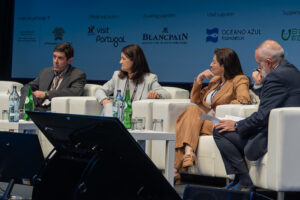
In preparation of “Our Ocean Conference” to be hosted by Greece 16-17 of April, Dr. Dionysia-Theodora Avgerinopoulou, the Greek Special Envoy  for the Ocean, participated in a panel discussion of the 11th Annual World Ocean Congress in Lisbon organized by the Economist. Dr. Avgerinopoulou focused on the need to redirect and increase the finance flows towards more ocean-sustainable investments. At the same time, she stated that Greece has created an enabling regulatory environment to this end.

“Greece has devoted more than 38% of the national RRF funds to Green and Blue Economy projects. Prime Minister of Greece Kyriakos Mitsotakis has shown real leadership. He has already passed the first national climate law and the necessary legislative framework for the transition to decarbonization and the blue economy is in place” said Dr. Dionysia-Theodora Avgerinopoulou Special Envoy for the Oceans, asking private sector companies to invest in Greece’s Blue Economy sector.

Other panelists included Mr. Francisco Saraiva Gomes, founding partner and chief investment officer of “Ocean 14 Capital” and Ms. Catarina Martins, chief sustainability officer of “Mowi” organization. The panel discussion was moderated by the editorial director of the Economist Impact, Mr. Charles Goodard.

“Sustainable Blue Economy is about ocean protection, technological progress, innovation, and job creation. The industries realize the need for transition. The process is ongoing and we need a more holistic view of how we envision the blue economy.  We have to develop win-win initiatives that will contribute to the creation of more jobs and sustainable growth and also tackle some of the most important stresses the ocean undergoes these days, such as ocean acidification, biodiversity loss, and plastic pollution.  Greece has one of the five biggest blue economy sectors in the EU. Shipping, sustainable tourism, and fishing already employ hundreds of people and offer a vast array of investment opportunities. On top of that Greece aspires to lead the way in the rising sectors of the blue economy, such as RES and pharmaceuticals, or nature-based projects. It builds hubs of innovation, upscales successful pilot projects like the GRECO islands, and plans to move towards the electrification of several of our ports and upgrade the coastal infrastructure.” she added.


Please follow and like us:
D. Avgerinopoulou was appointed a member of the Parliamentary Committee on European Affairs

D. Avgerinopoulou was appointed a member of the Parliamentary Committee on European Affairs

Member of Parliament for the Prefecture of Ilia, N.D., and Chairman of the Environment Committee, Dr. Dionysia – Theodora Avgerinopoulou, was appointed Member of the Special Standing Committee on European Affairs of the Parliament . The Standing Committee on European Affairs is responsible for the institutional affairs of the European Union, but also for the issues of cooperation between the Greek Parliament and other national parliaments of the European Union, the European Parliament and the Conference of European Parliamentary Affairs Committees. (COSAC).
It is also responsible for European policy issues and the actions of the EU institutions with regulatory content. The Commission can give an advisory opinion on these issues, while in parallel with the advisory process, the Commission has the opportunity to examine the draft EU acts.

Dr. Avgerinopoulou said that it is a special honor for her to be included in this Commission that has such important issues to work on, such as the plan – EU response to the energy crisis, ‘RePowerEU’, but also the results of the Conference on the Future of  Europe.

Ms. Avgerinopoulou is a Specialist in Public International and European Law, having taught at Universities Abroad, and has worked, inter alia, in the European Commission Legal Service in Brussels and the European Commission Delegation to the UN in New York.

Please follow and like us:
D. Avgerinopoulou the President of the Parliament’s Environment Committee, In Tilos for ‘Just Go Zero Tilos’

D. Avgerinopoulou the President of the Parliament’s Environment Committee, In Tilos for ‘Just Go Zero Tilos’

The President of the Parliament’s Environment Committee and Member of Parliament for Ilia, ND, Dr. Dionysia – Theodora Avgerinopoulou, visited Tilos for the inauguration of the innovative “Just Go Zero Tilos” program. The innovative program aims to transform Tilos into the first zero waste island and is implemented with the expertise of Polygreen, which provides a single solution for the management and recycling of hazardous and non-hazardous waste, in collaboration with the Municipality of Tilos.

The Chair of the Environment Committee said:
Within the framework of the innovative ‘Just Go Zero Tilos’programme, important environmental projects, green infrastructure projects and actions for the efficient management of waste will be implemented. The Government of the New Democracy has set the bar high from the outset for the promotion of sustainability in the country’s islands and tourist destinations, as well as the strengthening of renewable energy sources.
It is of utmost importance to turn our islands into green and energy self-sufficient destinations, both for the protection of the cultural and natural environment and the biodiversity of the islands that need special protection against the climate crisis, and for the promotion of sustainable tourism. Already the initiative of the Prime Minister, Mr Kyriakos Mitsotakis, for the GR- eco Islands model programme for tourism and green islands is attracting international interest“.

Please follow and like us:
D. Avgerinopoulou at the meeting of the Parliamentary Standing Committees with a delegation of the Christian Social Union of Bavaria

D. Avgerinopoulou at the meeting of the Parliamentary Standing Committees with a delegation of the Christian Social Union of Bavaria

The meeting of the cross-party delegations of the Parliamentary Standing Committees with the delegation of the Bavarian Parliamentary Group was attended by the Member of Parliament for Ilia, ND, Dr. Dionysia – Theodora Avgerinopoulou, as a member of the delegation of the Standing Committee on Public Administration, Public Order and Justice.

During the meeting, the two delegations exchanged views on the current situation of migration and refugee flows, the impact of the war in Ukraine and Greece’s assistance in the new refugee crisis, the progress of the negotiations on the new pact on migration and asylum and finally the challenge of providing housing, schooling and social benefits as well as access to the labour market for refugees and  migrants.

In the margins of the meeting on the migration issue, the climate migration dimension was also discussed and the two delegations exchanged views on further deepening the cooperation between Greece and Germany in the fields of climate action, agri-food and food security, the transition to a zero-carbon economy, sustainable management of natural resources, sustainable investments and the creation of green job positions, but also the instrumentalisation of energy, which was also demonstrated by Russia’s illegal invasion of Ukraine.

Finally, a central point of the discussion was the need for the exchange of technical knowledge and further application of new technologies in the above-mentioned issues, especially in the protection of Greece’s external borders, which are also the external borders of the European Union.

Please follow and like us:
Address by President of the Parliament’s Environment Committee, D. Avgerinopoulou, “We are an example for the Mediterranean”,at the “Blue Flags” event

Address by President of the Parliament’s Environment Committee, D. Avgerinopoulou, “We are an example for the Mediterranean”,at the “Blue Flags” event

The President of the Environment Committee of the Parliament and Member of Parliament for Ilia, ND, Dr. Dionysia – Theodora  Avgerinopoulou, congratulated the Hellenic Society for the Protection of Nature (EEPF) and the local government, for the designation of our country being ranked second in the world in Blue Flags, pointing out that we are an example for the Mediterranean. In her address, Ms. Avgerinopoulou referred to the initiatives undertaken by the Government involving the reduction of single-use plastics, the  confrontation of coastal erosion and protection of Natura sites, expressing the Environment Committee’s full support for this important institution. Ms Avgerinopoulou said: “The “Blue Flag” is a global symbol of coastal quality, through which, on the one hand, the beaches of our country are promoted for tourism and, on the other hand, the sustainable management of the complex  ecosystems of our coasts is promoted in the most direct and effective way, while the conditions for the safety and health of beach attenders are ensured, as well as environmental education and information“.

Finally, she expressed her conviction that we can do even better and create the conditions for all our visited beaches to be awarded the Blue Flag.

Below is the full text of her address:
“Dear representatives of the Hellenic Society for the Protection of Nature,
Honorable representatives of the environmental and tourism sector,
“The Greek Environmental Protection Agency, the Environmental Protection and Tourism Association, and the local
authorities,
friends:
On behalf of the Special Standing Committee on the Environment of the Parliament, I welcome this year’s event to announce the “Blue Flag” award winners, which is indeed an anniversary event, as it marks 35 years of implementation, and I congratulate you for your long term and significant work. The Environment Committee and the Subcommittee on Water Resources of the Parliament have long supported this important international programme, which has now become an international institution and which contributes to the
protection of both the marine environment and the public health and safety of beach attenders, while enhancing the tourism development of the awarded areas. It is also in line with all the actions of the Environment Commission which aim to fulfil the UN’s Global Sustainability Goal, number 14 for the protection of the seas, as well as the country’s environmental commitments under international, European and national law.

At the same time, they complement the efforts of both the Parliamentary Committee and the Government, as well as the Prime Minister  himself, Mr. Kyriakos Mitsotakis, for the protection of the marine areas of NATURA 2000 and marine biodiversity, as well as the legislative initiatives for the drastic reduction of single-use plastics, but also to address the phenomenon of coastal erosion due to many factors, mainly the climate crisis. The “Blue Flag” is a global symbol of coastal quality, which is linked to the quality of bathing water in thousands of beaches, marinas and related tourist destinations, through which, on the one hand, the beaches of our country are promoted for tourism and, on the other hand, the sustainable management of the complex ecosystems of our coasts is promoted in the most direct and effective way, while the conditions for the safety and health of beach attenders are ensured, as well as environmental education and information.

For the visitor, a beach with a Blue Flag is a safe place for recreation,
for local authorities, it is a”trophy” that demonstrates effective management,
for the younger generations who have already grown up with the image of the “Blue Flag” on the nearest beach, as we have in Ilia, after 35 years of operation of the institution, this flag is an integral part of the image, the perception we have of our seas, it is a “part” of our holiday frame.
And that is how we want our beaches in Greece to continue to be.
We are proud of the fact that our country is always high in the global ranking in terms of awards for its coasts and has 14% of the total number of awarded coasts among the 48 countries participating in the Program.
We are an example for the Mediterranean.

However, we are confident that we can do even better and create the conditions for all our beaches to be awarded the Blue Flag. We need both to ensure the prevention of marine pollution from land and sea sources and to develop the necessary infrastructure. With the motto – a “Blue Flag” on every beach, I congratulate you once again!

Thank you!”

Please follow and like us:
Dr. Avgerinopoulou addresses the Greek Parliament concearning the opinion of the Environment Committee on the Climate Bill

Dr. Avgerinopoulou addresses the Greek Parliament concearning the opinion of the Environment Committee on the Climate Bill

Ladies and Gentlemen,
Minister, Deputy Minister,
Mr. Secretary General,

I have the honour to inform you that the opinion of the Environment Committee on the Climate Bill in its main points is as follows:


It is the common understanding of our Members that the stakes arising from the impending climate crisis are great – they concern the health and survival of all living organisms on our planet. The objective of keeping the average global temperature from rising above 1.5°C by 2050 does not seem to be achieved by current international, regional and national action. On the contrary, we are heading towards almost double the average global temperature increase. Following the release of the recent Intergovernmental Panel on Climate Change (IPCC) report in 2022, which found that global net anthropogenic emissions have continued to increase across all major greenhouse gas groups and that harmful carbon emissions from 2010-2019 have never, ever, been higher, highest in human history, it is becoming clear that the legal and political response to the climate crisis so far is not sufficient and we must take more effective action immediately, or else the world, as the UN Secretary-General has warned, is on a “fast track” to disaster.

At the same time, the energy autonomy and security of Europe, and consequently of our country, is following recent geopolitical developments, at the centre of the EU’s new energy policy, as can be seen from the recent REPowerEU. In this light, it seems that with each passing day it becomes more and more imperative to accelerate the green and just energy transition. In this context, the text of Greece’s first climate law is a fact. It comes to strengthen the pre- existing relevant legislative framework and to accelerate Greece’s action against the climate crisis. The Ministry of Environment and Climate presents a law that responds to the demands of science and to the international and regional commitments of our country in terms of its contribution to mitigating the climate crisis, but also its adaptation to it and its armouring. We therefore give the text of the country’s proposed climate law a positive sign in principle. Besides, the Greek Climate Law does not fall short in terms of content, on the contrary, it refers to and covers the main points that the climate laws in the majority of EU Member States refer to.

I briefly mention the following points for improvement –
1) In its chapeau, i.e. in the introductory part of the Law, it would be good to make explicit reference to the UN Framework Convention on Climate Change and the Global Sustainability Goal 13.
2) With regard to the preparation of the National Adaptation Strategy to Climate Change (NASCC), which is now being prepared by the Ministry of Climate Change and Civil Protection, the participation of the Ministry of Environment and Energy should be upgraded, as the role of the Ministry of Environment and Energy is crucial in the protection of the natural environment and, in this case, its adaptation to climate change.
3) For the preparation and monitoring of the Regional Climate Change Plans (RCCPs), additional staff should be recruited in the Regions, specialized in climate crisis issues, to assist the Regions on a permanent basis. The relevant Directorates could be renamed as Directorates for Environment, Climate and Spatial Planning.
4) We welcome the adoption of the innovative tool of sectoral carbon budgets as a necessary tool for monitoring the progress of climate action and performance of businesses and the Greek state, as well as an indicator of sustainable financing.
5) We recall that in terms of the general policies and measures introduced by the bill, our Committee has already placed particular emphasis on the development of environmental and climate innovation, such as biomethane and green hydrogen and the substitution of fossil fuels by renewable and zero-emission fuels.
6) Regarding Article 10 and adaptation and shielding issues in general, we would like to see a greater emphasis on natural ecosystems and their shielding, but also their use as sinks with the development of corresponding projects and green infrastructure.
7) While, Particular reference deserves to be made to sub-paragraph i of para. 1 of Article 10, as it refers to the circular carbon economy, i.e. policies and measures to increase greenhouse gas absorption from natural ecosystems, such as our forests, or through their storage in geological formations or by reusing them. This passage refers directly to one of the most immediate solutions to global warming, since it aims to absorb excess carbon dioxide from the atmosphere. It is possible to absorb carbon dioxide either from specific emission sources or directly from the atmosphere itself.

We are in the critical decade for carbon capture, storage and reuse. If not now, then when? When is it too late? Scientists in Greece and abroad and Greek companies are already working on similar projects. Greece must work within the EU and take the lead in reviewing and updating the relevant national, European and international legislative framework. A generous funding of these technologies and businesses will also be needed. At the same time, I recommend the creation of an international or European Centre for the Coal Cycle Economy based in Greece.

Further, we welcome the Greek government’s commitment to coal decarbonisation by 2028, despite recent international developments, and we hope that we will be able to use the review clause for faster decarbonisation by 2025.  The regulations on electromobility are comprehensive and resolve many issues, while the obligation to acquire public electric vehicles could soon be extended across the country. And the electromobility of ships for coastal shipping are technologies that are slowly maturing.

As for buildings, it should be noted that climate change has been identified as an ‘urban issue’. The IPCC report stressed that: rethinking the way cities and other urban areas operate could make a significant contribution to mitigating the more severe impacts of climate change in the future. In this spirit, we welcome the provisions on buildings and, in general, the improvement of the way cities operate, and we look forward to the relevant legal framework being complemented by the legal framework for smart cities. It is also important that all citizens who wish to install photovoltaic panels on the roof, a truly long-awaited regulation brought about by the climate law, should be able to do so. As a reminder, the use of renewable energy sources has been identified by the UN Secretary-General as: “an essential, global public good”. The strengthening of the climate change dimension in environmental permitting is also substantial, as is the regulation on emission reductions from activities outside the European Emissions Trading Scheme. It should be noted that Greece could also play a substantial role and leadership on shipping and climate issues, and we need to launch the establishment of the Green Shipping Centre, a proposal that the Prime Minister himself, Mr Kyriakos Mitsotakis, has already submitted to the European Commission.

While the Gr-eco islands Strategic Initiative Framework is important for our country’s environmental and climate action, and responds to the needs of islandhood. It has attracted the interest of the international community and promotes Greece everywhere in the most beautiful way.
Other buildings at risk, such as those located in the coastal zone, due to coastal erosion, should perhaps be added to the insurance of buildings at risk from climate change, and the compulsory insurance of buildings in Greece against climate change should be extended. Climate financing is rightly one of the main subjects of the draft law and should also necessarily follow the European taxonomy. We  should also fund climate actions in third countries and strengthen our presence internationally, for example, by funding the organisation of an upcoming World Climate Conference in Greece.

We welcome the establishment of the climate institutions, namely, the National Observatory for Climate Change, the National Council for Adaptation to Climate Change, the Climate Dialogue Website, but also the Scientific Committee on Climate Change, which should consist  of more than eight members in order to give the opportunity to more disciplines directly related to the interdisciplinary nature of the climate change phenomenon to be represented. While the Annual Progress Report on Mitigation and Adaptation to Climate Change under
Article 28 should necessarily be submitted to the Parliament for information and debate, in particular to the Parliament’s Environment Committee.

In a subsequent development of this bill, and taking into account RepowerEU, Fit for 55, the new IPCC report and in general the relevant legislative and scientific developments, we propose that the Climate Law be supplemented with additional regulations for agriculture and livestock, methane, ecosystem protection, green shipping, protection of the marine environment from climate change, water management in relation to climate, climate education,for the development of the energy transmission network, etc.

Looking the acute problem of the climate crisis in the eye, it is very encouraging to see additional action on climate in our country as well. We expect the policies, regulations and market instruments provided for in the Climate Law to prove effective. If these are implemented widely and fairly, with the participation of society as a whole, we will be able to achieve deep reductions in greenhouse gas emissions and perform the noblest task: to protect life on the planet.

Please follow and like us:
Speach at the Greek Parliament about the new  Climate Bil

Speach at the Greek Parliament about the new Climate Bil

Ladies and gentlemen,

The stakes arising from the impending climate crisis are great, concerning the health and survival of all living organisms on our planet. The objective of keeping the average global temperature from rising by more than 1.5 degrees Celsius by 2050 does not seem to be achieved by the climate action that has been taken so far. Alongside the climate crisis we are also facing a geopolitical crisis, an illegal invasion of sovereign state territory in which energy and its conditional supply is used as a practice and as a means of war diplomacy.

It is, therefore, a decision made by the Government of the New Democracy ( Nea Dimokratia) and the Prime Minister, Mr.Kyriakos Mitsotakis, as well as the Parliament to defend our country against these crises and to diversify our energy sources, to develop as much as possible the Renewable Energy Sources and to reduce the consumption of energy that we need in our economy. The energy autonomy and security of the European Union and of Greece is a primary concern of the new energy policy of the European Union, as shown by REPowerEU. In this international context, the text of the country's first climate law is a fact and an event of particular importance and symbolism. It comes to strengthen the pre-existing relevant legislative framework and accelerate Greece’s energy transition and climate action.

The Ministry of Environment and Energy presents a law that responds to modern needs, the imperatives of science and the international commitments of our country. The Greek climate law does not fall short in content. On the contrary, it refers to and covers the main points to which the climate laws in the majority of EU Member States refer:

* It underpins national and regional strategies for adaptation to climate change.
* It adopts sectoral carbon budgets as an innovative and indispensable tool for monitoring the progress of climate action of businesses and the Greek state, and as an indicator of eligibility for green financing.
* It supports the development of environmental and climate innovation including biomethane and green hydrogen.
* After 2030 it will allow the registration of zero emission vehicles only.
* It consolidates the Government's commitment to privatisation by 2028, with a review clause for faster decarbonisation by 2025.
* It promotes and resolves issues around electromobility in land transport and, together with the new legislative framework for  “smart cities” , places the functioning of urban areas on a new basis, which will contribute significantly to mitigating climate change and its  impacts and better protect health and improve the quality of life of residents.

The bill provides for regulations that will offer financial support to households and small and medium- sized businesses, such as, for example, the regulation of the installation of photovoltaic panels on the roof and the replacement of household appliances. The strengthening of the climate change dimension in environmental permitting is also essential, as is the regulation of emission reductions from activities outside the European emissions trading scheme.

Furthermore, the strategic framework of the 'GR- eco Islands’ initiative is important for the environmental and climate action of our country and responds to the needs of insularity and the vulnerability of our islands ecosystems. The establishment of new institutions of climate governance, the National Observatory for Climate Change, the National Council for Adaptation to Climate Change, the Climate Dialogue website and the Scientific Committee on Climate Change are also significant. Special mention should be made of the ninth subparagraph of paragraph 1 of Article 10, as it brings into the public debate and includes the promotion of the circular carbon economy among the general measures of the country’s climate policy. It explicitly provides for the possibility of taking action aimed at increasing the absorption of greenhouse gases from natural ecosystems, such as our forests, or by storing them in geological formations or reusing them.

This paragraph is important because it refers directly to one of the most immediate solutions to the phenomenon of climate change, as it is now possible to gradually absorb the excess carbon dioxide that is either emitted from specific sources, such as transport and industry, or concentrated everywhere in the atmosphere. These technologies are now feasible, as we have said, and need further support for their widespread application. Scientists in Greece and abroad and Greek companies are already working on similar projects. Our country must work within the European Union and take the lead in reviewing and updating the relevant national, European and international legislative framework, and I also suggest the creation of a European centre for the circular carbon economy based in Greece.

This is a crucial decade for carbon capture, storage and reuse. If we have such immediate solutions to tackle the climate crisis, why do we not do it? If not now, then when? Climate law offers us the right opportunity to do so.

Thank you very much.

Please follow and like us: